


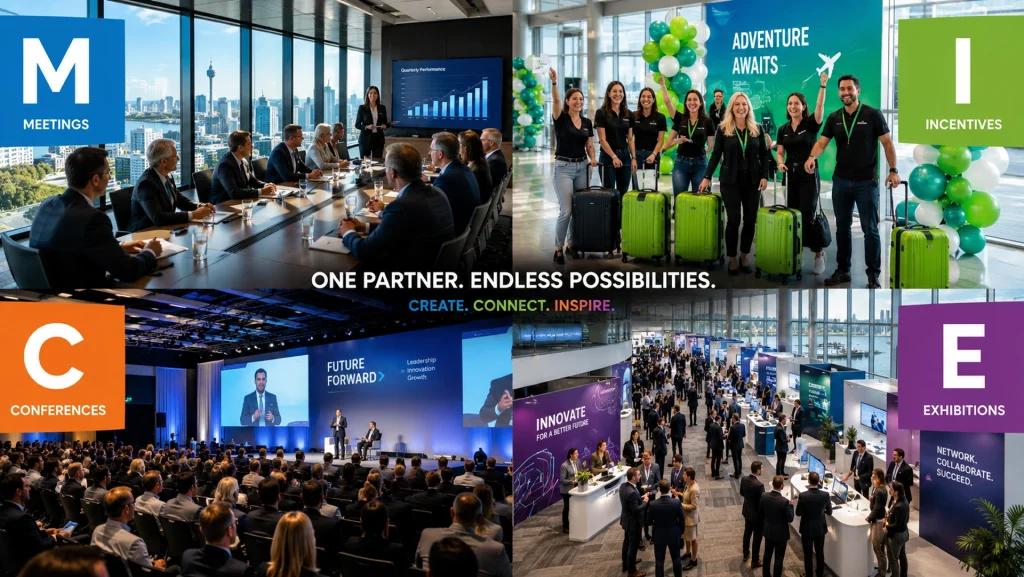
MICE stands for Meetings, Incentives, Conferences and Exhibitions. It is a term used across the business events and travel industry to describe organised programmes created for a corporate or professional purpose.
The four categories often share venues, travel, accommodation, production and supplier management. However, each has a different primary objective. Understanding those differences helps Australian businesses write clearer briefs, select suitable partners and measure the right outcomes.
What does MICE mean?
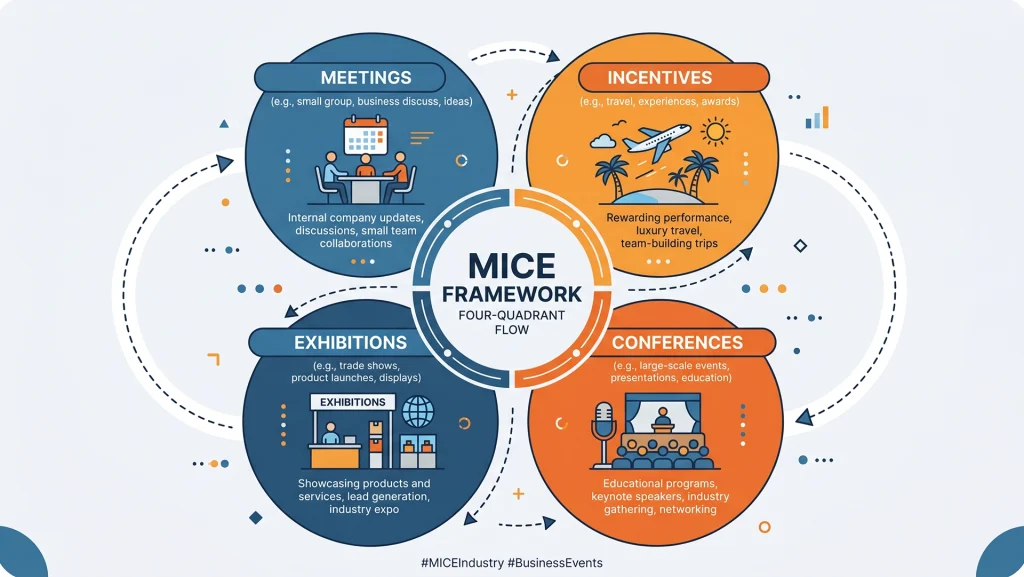
MICE is an industry framework for grouping four types of business events:
- Meetings: Business gatherings focused on decisions, planning or alignment.
- Incentives: Reward programmes and travel experiences earned through performance.
- Conferences: Larger programmes designed for communication, learning or professional development.
- Exhibitions: Trade shows, expos and showcase environments that connect organisations with a target market.
MICE is not a single event format. It describes connected categories that may require different planning skills, suppliers and measures of success.
Why MICE matters in Australia
Tourism Research Australia classifies business meetings, corporate events, conventions, conferences, seminars, exhibitions and trade fairs as business events. Its official data reports that visitors travelling for business events spent $17.2 billion in Australia during 2025. Beyond visitor spending, these events can support trade, investment, knowledge exchange, networks, innovation and productivity.
Source: Tourism Research Australia business events data. The figures are updated periodically, so use the source when preparing a current business case.
The four parts of MICE
Meetings
Meetings bring a defined group together to discuss, decide or plan. Examples include leadership offsites, board meetings, annual general meetings, sales meetings and strategy sessions.
The main objective is usually alignment or decision-making. Useful measures may include attendance, completed actions, participant feedback and whether agreed decisions were implemented.
Incentives
Incentives recognise employees, salespeople or business partners who meet defined performance criteria. The reward may be a domestic experience or an international group journey.
Unlike ordinary corporate travel, participation is earned. A successful programme connects qualification rules, communication, the travel experience and measurement. Read the practical guide to what incentive travel is for more detail.
Conferences
Conferences bring larger groups together around content, communication and professional development. They may include keynote presentations, panels, workshops, networking, exhibitions and social functions.
National sales conferences, franchise conferences, industry summits and multi-day internal programmes fit this category. Delegate management, production, speakers, content and travel can make them more complex than a standalone meeting. See the guide to planning a corporate conference in Australia.
Exhibitions
Exhibitions create a physical or digital environment where organisations present products, services or ideas to a targeted audience. Examples include trade shows, industry expos, partner showcases and branded stands within a conference.
Planning may involve floor layouts, stand design, exhibitor management, freight, utilities, registration and lead capture. Success measures can include qualified conversations, leads, demonstrations, attendance and brand exposure.
MICE categories compared
| Category | Primary purpose | Typical success measure |
|---|---|---|
| Meeting | Decide, align or collaborate | Decisions made and actions completed |
| Incentive | Motivate and recognise performance | Qualification, performance and retention |
| Conference | Share knowledge and connect a larger audience | Learning, engagement and organisational outcomes |
| Exhibition | Connect buyers, sellers and ideas | Attendance, leads, meetings and commercial value |
How MICE differs from general event management
Event management is a broad discipline covering the planning and delivery of organised gatherings. MICE is more specific to business and professional programmes, particularly those involving travel, delegates, commercial objectives or specialist production.
A company celebration can be a corporate event without fitting neatly into one MICE category. A sales conference with an exhibition area and an incentive experience may include several MICE components in the same programme.
The label matters less than the objective. Classifying each component helps the planning team identify the right expertise, budget and measurement approach.
Examples of MICE programmes
- Leadership meeting: A two-day strategy offsite for senior managers.
- Sales incentive: A group trip for employees who reach an agreed target.
- National conference: A multi-day programme combining business updates, learning and networking.
- Franchise conference: A gathering for franchisees that may include presentations, supplier sessions and awards.
- Industry exhibition: An expo connecting suppliers, buyers and professional audiences.
- Combined programme: A conference with an exhibition, awards event and incentive extension.
Why businesses invest in MICE
MICE programmes can support different business objectives when they are designed around a clear purpose:
- Alignment: Bring leaders or teams together around strategy and priorities.
- Recognition: Reward high performance through a meaningful experience.
- Learning: Share knowledge, develop skills and introduce new ideas.
- Connection: Strengthen relationships with employees, customers, partners or franchisees.
- Commercial activity: Generate leads, showcase products and support sales conversations.
- Culture: Create shared experiences that reinforce organisational values.
Measurement should follow the primary objective. Attendance alone may not show whether a leadership meeting improved alignment or whether an exhibition generated useful commercial opportunities.
How to plan a MICE programme
1. Define the objective
Decide what the programme should achieve and which audience needs to participate. This determines whether the brief is primarily a meeting, incentive, conference, exhibition or a combination.
2. Set the scope and budget
Establish dates, delegate numbers, destinations, programme length and essential requirements. Include travel, accommodation, venues, catering, production, registration, creative, staffing and contingency where relevant.
3. Build the right internal team
Clarify who owns strategy, content, approvals, communications and budget. HR, sales, marketing, finance and leadership may each have different responsibilities depending on the programme.
4. Select suitable partners
Look for experience that matches the format and complexity of the brief. Review comparable case studies, meet the proposed team and ask how suppliers, budgets, communication and contingencies will be managed. The guide to choosing an event management company provides a practical evaluation framework.
5. Plan the complete participant journey
Consider every stage from the invitation and registration process through travel, arrival, programme participation and follow-up. The experience should feel connected rather than assembled from separate suppliers.
6. Measure the outcome
Agree on useful measures before delivery. Depending on the objective, these may include participation, learning, engagement, qualified leads, sales activity, retention or completed business actions.
Australian MICE destinations and considerations
Australia offers major city venues, regional retreats and incentive destinations. Sydney, Melbourne, Brisbane, the Gold Coast, Adelaide and Perth provide different combinations of air access, accommodation, conference infrastructure and local experiences.
Destination decisions should account for delegate origin, travel time, seasonality, accessibility, venue availability and the purpose of the programme. Regional locations can create focus or a stronger sense of occasion, while major cities may simplify transport and supplier access.
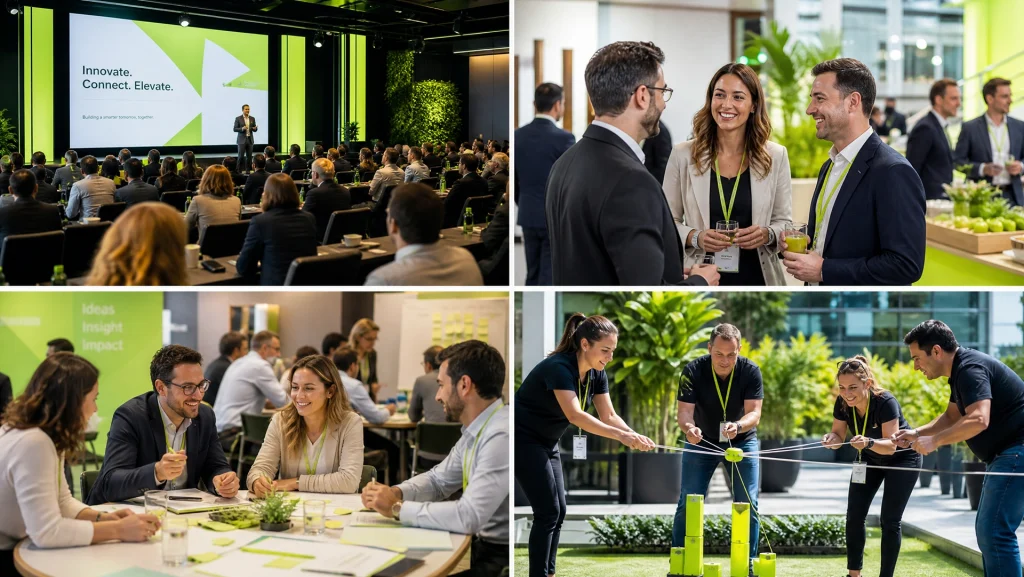
For current destination ideas, venues and sample programmes, consult Tourism Australia’s official business-event destination resources.
How DNA Events supports MICE programmes
DNA Events plans and delivers corporate incentives, conferences and events in Australia and internationally.
Through its Pitch to Program approach, a dedicated event manager remains involved from the initial concept and destination pitch through detailed planning and on-site delivery. This continuity helps keep the objective, participant experience and operational decisions aligned.
Explore DNA Events’ case studies for examples of incentive, conference and event programmes.
Frequently asked questions
What does MICE stand for?
MICE stands for Meetings, Incentives, Conferences and Exhibitions.
Is MICE the same as business travel?
No. Business travel can involve an individual travelling for work. MICE usually refers to organised group programmes created around a meeting, reward, conference or exhibition objective.
What is the difference between a meeting and a conference?
A meeting is generally a more focused gathering for discussion, planning or decisions. A conference often has a larger audience, a structured content programme and more complex delegate and production requirements.
Is incentive travel part of MICE?
Yes. Incentive travel is represented by the “I” in MICE. Participants earn the experience by meeting defined performance criteria.
Can one programme include several MICE categories?
Yes. A conference may include a leadership meeting, exhibition area and incentive experience. Each component should still have a clear purpose, owner and measurement approach.
How much does a MICE programme cost?
Cost depends on the format, destination, delegate numbers, duration, travel, accommodation and production requirements. A detailed brief is needed before a realistic budget can be prepared.
Planning your next business event
Begin with the objective, audience and type of programme you need. From there, build a brief that connects budget, participant experience, delivery and measurement. To discuss an upcoming meeting, incentive, conference or corporate event, contact DNA Events.
About the author
Matthew Smith is an Event Manager at DNA Events & Travel and a SITE Certified Incentive Specialist. He plans and delivers corporate events, conferences and incentive travel programmes across Australia and internationally, with a focus on detailed coordination, destination research and on-site execution.
View all articles by Matthew Smith or connect with him on LinkedIn.


